Archive | government

What is the purpose of government under capitalism?

It is to protect rights that governments are instituted. A proper government’s only responsibility is to protect the rights of the individual, by banning the initiation of force, thus making all relations between men peaceful, i.e., free from the threat of violence and fraud.

In a political context, freedom has only one specific meaning — freedom from the initiation of force by other men. By initiation I mean those who start the use of force to achieve their ends, i.e., a bank robber. Only the initiation of force against a man can stop his mind, thus rendering it useless as a means of survival. Only by the initiation of force can a man be: prevented from speaking, or robbed of his possessions, or murdered. Only through the initiation of force can a man’s rights be violated.


Suggested Reading:

The Nature of Government by Ayn Rand

0 | capitalism, government

What do you mean by the initiation of force?

In a political context, freedom has only one specific meaning — freedom from the initiation of force by other men. By initiation of force I mean those who start the use of force to achieve their ends, i.e., a bank robber. Only the initiation of force against a man can stop his mind, thus rendering it useless as a means of survival. Only by the initiation of force can a man be prevented from speaking, or robbed of his possessions, or murdered. Only through the initiation of force can a man’s rights be violated.

0 | force, government

Can citizens delegate the right to initiate force to government?

Citizens may not delegate the right to initiate force to government, as they do not possess the right to start force to begin with.

As Ayn Rand has commented “there is no such thing as the right to enslave.”

As no individual in his private capacity, as a citizen, may initiate force against others, neither may he in his public capacity as a state official start force either.

0 | force, government

What do individuals delegate to government?

In order to place the retaliatory use of force under objective legal control — that is, under clearly defined laws that are logically deduced from the principle of rights — those who make up society delegate their right to retaliate against those who initiate force, to government.

0 | government

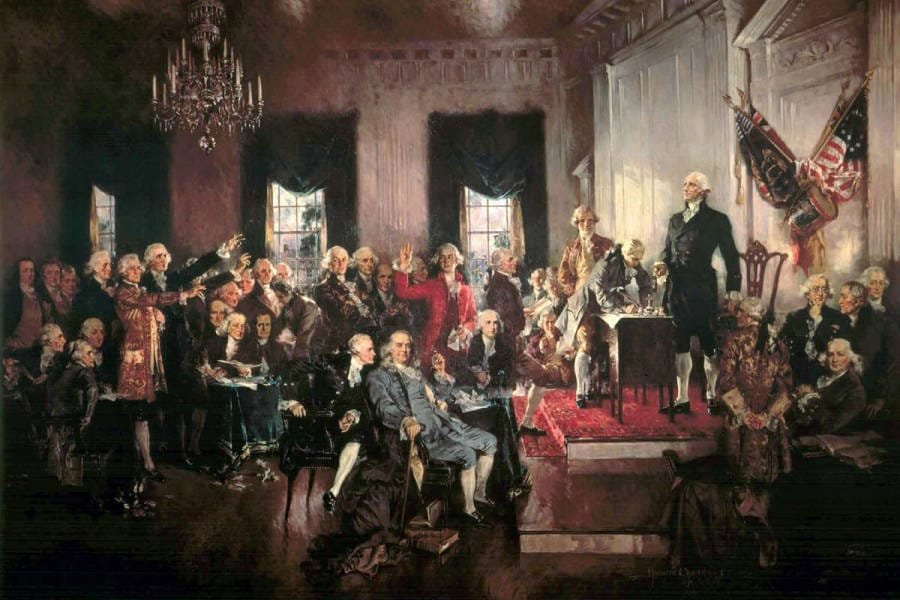
What is the purpose of the constitution?

To ensure no despot — whether that despot be a single dictator, an elite political pressure-group, or the befuddled democratic majority of the moment — may usurp the powers of government, and turn its machinery upon its citizens, each and every aspect of government action is codified, and carried out, according to objectively defined laws.

The supreme legal document of a proper society is the constitution — a citizen’s protection not only against private criminals, but public ones also.

152 | constitution, government

What is the purpose of law?

In a free society each and every man lives under a rule of law, as opposed to a whim-ridden rule of men.

Such a rule of law has only one purpose: to protect the rights of the smallest minority that has ever existed — the individual.

Such laws form a non-contradictory body of principled legislation, which hold a man innocent until he can be proven guilty according to an objective standard, as opposed to a plethora of regulations which hold a man guilty until he can somehow prove himself innocent, to the gratification of a bureaucrat able to gain a foothold in public office.

In a free society it is the actions of government — and not the actions of citizens — that are regulated.

0 | government, law

Does government’s monopoly on the use of force give it the right to initiate (start) force against others?

Under no conditions may government violate anyone’s rights, by initiating force against others. A proper government is permitted to use force to retaliate against a thief who has initiated force against someone (in the act of robbing them). However, a proper government is not permitted to copy the means of private criminals by initiating force against its citizens. The government is not even permitted to rob them of their wealth–even, or rather especially, if the stolen loot is to be used for so called “noble” purposes, such as for the sick and poor. No end (even for the “poor”) ever justifies an illegitimate means (the initiation of force). Any man who initiates force against others is a dictator, and should be treated as such, to the extent he initiates force.

0 | force, government

How does government carry out its’ duties in practice?

To protect rights, government require essentially three things: an army — to protect against foreign invaders, a police force — to protect against domestic criminals, and a court system — to settle honest disputes that arise, and to punish criminals according to objectively predefined laws.

155 | government

What would a society be without government, i.e., without the delegation of the use of force?

Man’s state in nature, where every man is allowed complete discretion in the retaliatory use of force, according to the laws of the jungle, is nothing more than a state of anarchy — perpetual civil war and gang warfare. If there were no legal agency to carry out such a task, each man would be forced to carry out retaliation at his own discretion, i.e., anarchy.

A modern day example of such a situation is Bosnia, where two gangs, or “competing governments” — the Croats and the Serbs — are competing with each other in the same geographical area.

0 | government

What is political power?

The power of a bureaucrat of a statist society is the power of fear — the power to initiate force. He can force you to do his bidding by legally threatening your life and freedom. Such power is derived by destroying, or threatening to destroy values — such as when your local IRS man confiscates your home for not paying your taxes, or the DOJ threatens you with a jail sentence for being too successful.

0 | force, government, power